
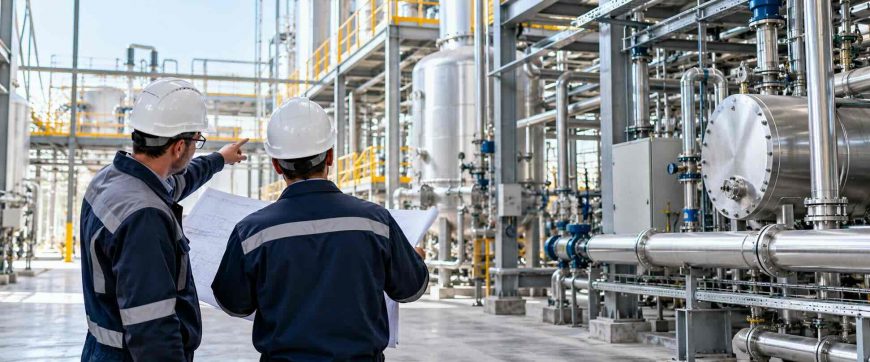
An Engineering Company plays a central role in transforming an industrial project from an initial concept into a fully operational production plant. In complex processing industries, successful project execution requires more than equipment selection: it depends on the coordination of process design, detailed engineering, manufacturing, installation and start-up activities.
Each stage influences the performance, reliability and long-term efficiency of the final installation.
For manufacturers operating in the edible oils, oleochemicals and biodiesel sectors, working with an experienced engineering partner helps ensure that technical decisions remain aligned with production objectives throughout the project lifecycle.
The Role of an Engineering Company in Industrial Project Development
Industrial plant development begins with the definition of production requirements, available raw materials and expected operating conditions.
Before equipment can be manufactured or installed, engineers must evaluate the technical feasibility of the proposed process and identify the most suitable plant configuration.
This preliminary phase establishes the foundation for subsequent engineering activities.
Key considerations include:
- Production capacity and expected operating conditions
- Raw material characteristics and product specifications
- Process technology selection
- Energy and utility requirements
- Equipment arrangement and maintenance accessibility
- Safety, environmental and regulatory requirements
A structured engineering approach allows these factors to be considered together rather than as independent decisions.
For an Engineering Company, the objective is to translate industrial requirements into a technically consistent project that can progress efficiently toward construction and operation.
From Basic Engineering to Detailed Plant Design
Once the main process requirements have been established, the project moves into engineering development.
Basic engineering defines the principal characteristics of the production system, including process flows, operating conditions and major equipment requirements.
Detailed engineering transforms these initial specifications into the technical documentation required for manufacturing, installation and integration.
Depending on the project, this phase may involve:
- Process flow diagrams and piping and instrumentation diagrams
- Equipment specifications and technical datasheets
- Piping layouts and plant arrangement
- Mechanical and structural requirements
- Electrical and instrumentation systems
- Automation and control system architecture
The coordination of these disciplines is essential.
Changes in equipment arrangement, for example, can influence piping requirements, maintenance access and installation procedures.
An integrated engineering workflow helps identify these interactions before they become operational or construction-related problems.
Equipment Manufacturing and Procurement Coordination
Engineering decisions must be translated into physical equipment that meets the project’s technical requirements.
This makes manufacturing and procurement important components of industrial plant development.
Equipment specifications need to account for operating conditions, material compatibility, construction standards and integration with the surrounding process.
Close coordination between engineering teams, manufacturers and suppliers helps ensure that equipment is produced according to the intended design.
Technoilogy combines engineering activities with equipment fabrication and procurement services, supporting the connection between technical design and industrial manufacturing.
The company manufactures equipment through its facilities in Italy and, when required, through other qualified workshops.
This approach helps maintain coordination between project requirements and equipment production.
How an Engineering Company Supports Plant Installation
The transition from manufacturing to installation introduces a different set of technical challenges.
Equipment must be positioned, connected and integrated according to the approved engineering documentation.
Installation activities also require coordination between mechanical, electrical, instrumentation and process disciplines.
Potential issues may include limited installation space, equipment interfaces, piping connections and the sequencing of construction activities.
Engineering supervision helps verify that the installation follows the intended technical requirements and allows potential discrepancies to be addressed during execution.
Technoilogy provides supervision during the main stages of plant erection, supporting customers as equipment and systems are assembled on site.
This continuity between design and installation is particularly important in complex processing plants, where individual sections must operate as a coordinated production system.
Commissioning and Start-Up: From Installation to Operation
Completing the physical installation of an industrial plant does not automatically mean that the facility is ready for production.
Commissioning and start-up activities are necessary to verify equipment functionality, establish operating conditions and progressively bring the process into operation.
These activities may involve mechanical checks, instrumentation verification, control system testing and the evaluation of process performance.
The specific sequence depends on the technologies installed and the requirements of the project.
During start-up, engineers assess how the different sections interact under actual operating conditions.
Important objectives include:
- Verifying the functionality of installed equipment
- Checking instrumentation and control systems
- Establishing stable operating parameters
- Coordinating material flows between processing sections
- Evaluating product quality and operating performance
- Identifying adjustments required for reliable production
Technoilogy supports these activities through qualified mechanical, electrical, instrumentation and process engineers involved in plant start-up operations.
The commissioning phase therefore represents a critical connection between the original engineering design and the plant’s practical industrial performance.
Engineering Company Expertise Beyond Plant Start-Up
The responsibilities of an Engineering Company can extend beyond the initial commissioning phase.
Once a plant is operational, manufacturers must maintain production reliability, manage equipment performance and respond to changing industrial requirements.
Technical assistance and personnel training contribute to these objectives.
Operators need to understand the equipment, process parameters and control systems involved in daily production.
At the same time, ongoing performance evaluation can help identify opportunities to improve operating efficiency.
Technoilogy provides personnel training, troubleshooting and technical assistance, including evaluations of product quality, energy consumption and plant reliability.
The company also supports studies for plant revamping and capacity increases.
These activities allow engineering expertise to contribute throughout the operating life of an industrial facility.
Integrated Engineering for Long-Term Plant Performance
The performance of an industrial plant depends on the relationship between its individual components and the effectiveness of their integration.
Process design influences equipment requirements, manufacturing affects installation, and commissioning determines how the engineered system performs under real operating conditions.
Treating these phases as connected activities helps reduce inconsistencies between project development and industrial operation.
For manufacturers, this integrated approach can support more reliable production, coordinated maintenance and greater flexibility when future modifications are required.
As an international Engineering Company specializing in edible oil processing, oleochemicals and biodiesel production, Technoilogy combines process know-how, engineering services and equipment manufacturing to support industrial projects across their lifecycle.
Conclusion
An Engineering Company contributes to industrial plant development by coordinating the technical activities required to transform a production concept into an operational facility.
From feasibility assessment and process design to equipment manufacturing, installation supervision and commissioning, each stage plays an essential role in achieving reliable plant performance.
The integration of engineering disciplines, manufacturing expertise and technical support helps manufacturers manage complex projects while maintaining consistency between design objectives and operating requirements.
Through its experience in industrial processing technologies, Technoilogy supports customers in developing and operating plants designed around specific production needs.