
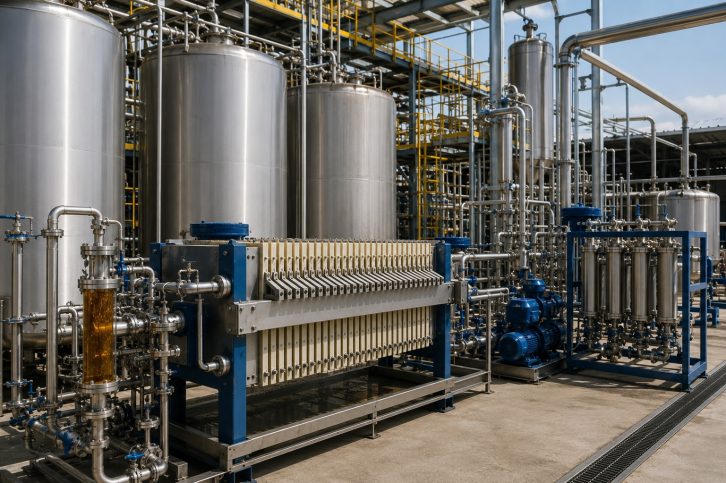
Advanced Oil Deacidification Processes: Chemistry, Technologies and Industrial Performance
Oil deacidification is a critical operation in edible oil refining, biodiesel feedstock preparation, and renewable fuel production. As refineries increasingly process lower-quality and waste-derived oils, controlling free fatty acid (FFA) content has become essential to ensure product quality, process stability, and economic efficiency. This article examines the chemistry, technologies, and engineering considerations behind advanced oil deacidification processes used in modern industrial plants.
The Role of Deacidification in Oil Processing
Free fatty acids are naturally present in crude oils and increase significantly in degraded or waste feedstocks due to hydrolysis and oxidation. Elevated FFA levels negatively impact downstream processing by increasing chemical consumption, promoting emulsions, and accelerating equipment fouling.
Deacidification aims to reduce FFA content to levels compatible with subsequent refining or conversion steps such as transesterification, physical refining, or hydrotreatment. In advanced plants, deacidification is no longer a standalone step but an integrated part of overall process optimization.
Sources and Impact of Free Fatty Acids
FFAs originate from several mechanisms:
- Hydrolysis of triglycerides in the presence of water and heat.
- Thermal degradation during frying or high-temperature processing.
- Oxidative reactions during improper storage and exposure to air.
High FFA content leads to:
- Soap formation in alkaline processes.
- Higher neutral oil losses.
- Increased wastewater generation.
- Lower catalyst efficiency in biodiesel production.
For this reason, effective deacidification is fundamental to both edible oil refining and waste-based biodiesel production.
Chemical Neutralization: The Conventional Approach
Chemical deacidification, also known as alkali neutralization, is the most established method for FFA removal. It involves reacting free fatty acids with alkaline solutions such as sodium hydroxide or potassium hydroxide to form soaps that can be separated from the oil phase.
Process Overview
- Mixing crude or pretreated oil with a controlled amount of alkali.
- Formation of soapstock through acid–base reaction.
- Separation via centrifugation or gravity settling.
- Optional water washing to remove residual soaps.
Advantages
- High FFA removal efficiency.
- Well-known and robust process design.
- Suitable for a wide range of oil types.
Limitations
- Neutral oil losses entrained in soapstock.
- Generation of wastewater requiring treatment.
- Increased operating costs for low-quality feedstocks.
Because of these drawbacks, chemical neutralization is increasingly complemented or replaced by alternative deacidification strategies.
Physical Deacidification in Modern Refining
Physical deacidification removes free fatty acids by thermal separation rather than chemical reaction. FFAs are distilled under high temperature and vacuum conditions, typically during the deodorization step of physical refining.
This approach is widely discussed in physical oil refining processes, where minimizing chemical inputs is a key objective.
Key Requirements
- Low phosphorus and metal content.
- Effective degumming and bleaching pretreatment.
- High vacuum systems and precise temperature control.
Benefits
- Minimal neutral oil losses.
- Reduced chemical and wastewater footprint.
- Simplified process layout.
Physical deacidification is particularly suited for vegetable oils such as palm oil and for integrated refining systems prioritizing sustainability.
Esterification-Based Deacidification for High-FFA Oils
For feedstocks with very high FFA content—such as used cooking oil or acid oils—acid-catalyzed esterification is often the most effective solution. In this process, FFAs react with methanol to form fatty acid methyl esters, reducing acidity while preserving oil yield.
This approach is commonly applied in biodiesel pretreatment and is closely linked to advanced oil neutralization strategies.
Process Characteristics
- Use of acid catalysts (e.g. sulfuric acid).
- Moderate temperatures (55–70°C).
- Longer residence times compared to alkaline systems.
Esterification enables the processing of waste-based feedstocks that would otherwise be unsuitable for conventional refining routes.
Integration with Biodiesel and Refining Operations
Deacidification performance directly influences the efficiency of downstream processes such as transesterification and physical refining. Poor FFA control results in higher catalyst consumption, unstable separation, and reduced product quality.
Integrated deacidification systems, combined with advanced oil filtration and dehydration, allow plants to maintain consistent operating conditions even with variable feedstock quality.
Automation and Process Control
Modern deacidification units rely on automation and real-time monitoring to adapt to fluctuating FFA levels. Typical control elements include:
- Online FFA analyzers.
- Automated reagent dosing systems.
- Temperature and residence time optimization.
These tools reduce overconsumption of chemicals and improve overall plant efficiency.
Economic and Sustainability Considerations
Advanced deacidification technologies reduce operating costs by minimizing oil losses and wastewater treatment requirements. From a sustainability perspective, they support the use of waste-derived feedstocks and lower the environmental footprint of refining and biodiesel production.
Although alternative technologies may involve higher CAPEX, the long-term reduction in OPEX typically results in attractive payback periods.
Frequently Asked Questions (FAQ)
What is the main purpose of oil deacidification?
Oil deacidification reduces free fatty acid content to improve product quality, process stability, and downstream conversion efficiency.
Which deacidification method is best for high-FFA oils?
Acid-catalyzed esterification is generally preferred for high-FFA feedstocks such as used cooking oil and acid oils.
Can physical refining replace chemical deacidification?
Yes, provided that effective pretreatment removes phospholipids and metals, physical deacidification can eliminate the need for chemical neutralization.
How does deacidification affect biodiesel production?
Lower FFA levels reduce soap formation, improve catalyst efficiency, and enhance biodiesel yield and purity.
Conclusion
Advanced oil deacidification processes are essential for modern refining and biodiesel production. By combining chemical, physical, and esterification-based technologies, industrial plants can efficiently manage variable feedstock quality while improving sustainability and economic performance.
As the industry moves toward waste-based and circular feedstocks, optimized deacidification will remain a key enabler of robust and future-proof oil processing systems.
Looking to optimize oil refining and biodiesel pretreatment processes?