
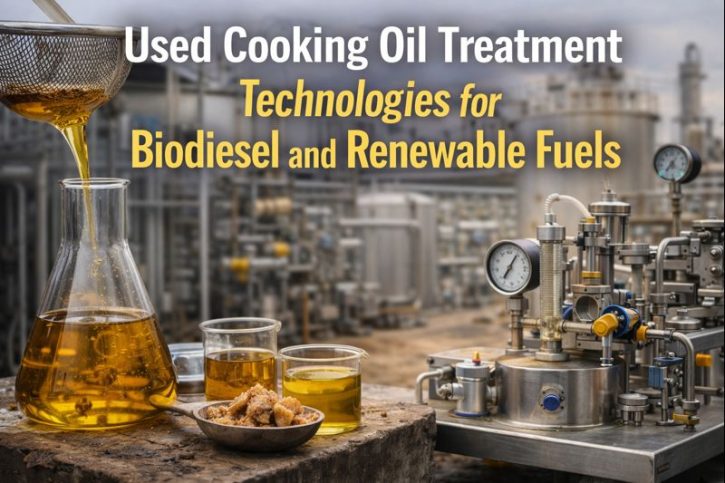
Used Cooking Oil Treatment Technologies for Biodiesel and Renewable Fuels
Used Cooking Oil (UCO) treatment has become a cornerstone of modern biodiesel and renewable fuel production. As the industry increasingly shifts toward waste-based feedstocks to meet sustainability targets and reduce raw material costs, the ability to process low-quality oils efficiently has become a decisive competitive factor. This article examines the chemistry, process design, and engineering strategies behind advanced UCO treatment systems used in industrial biodiesel plants.
The Strategic Role of UCO in Biodiesel Production
Used cooking oil represents one of the most attractive alternative feedstocks available to the biodiesel industry. Compared to virgin vegetable oils, UCO offers significantly lower lifecycle greenhouse gas emissions and reduced dependency on agricultural resources.
However, its technical complexity is often underestimated. Thermal degradation during frying, oxidation, hydrolysis, and contamination during collection and storage result in highly variable oil quality. Without proper treatment, this variability translates into unstable plant operation, higher operating costs, and reduced biodiesel yields.
Typical Composition and Contaminants in Raw UCO
Raw UCO contains a broad range of contaminants that negatively affect downstream processing. The most relevant include:
- Free fatty acids (FFA) generated through hydrolysis and thermal stress.
- Water absorbed from food matrices or introduced during improper storage.
- Suspended solids such as food residues, char, and polymerized fats.
- Oxidation and polymerization products that increase viscosity and foul equipment.
- Trace metals and inorganic salts originating from cookware, additives, and containers.
These impurities reduce catalyst efficiency, promote soap formation, and accelerate fouling in heat exchangers, separators, and reactors. A well-engineered UCO treatment system must therefore address both physical and chemical degradation mechanisms.
Objectives of an Industrial UCO Treatment Line
From a process engineering perspective, UCO treatment serves several critical objectives:
- Stabilizing feedstock composition to ensure predictable process behavior.
- Reducing FFA and moisture levels to meet transesterification requirements.
- Removing solids and gums that impair mass transfer and phase separation.
- Protecting downstream catalysts and equipment from premature deactivation.
Meeting these objectives improves conversion efficiency, reduces chemical consumption, and extends overall plant lifetime.
Mechanical Pretreatment: Filtration and Solid Removal
The first treatment stage focuses on removing suspended solids and coarse contaminants. Effective mechanical pretreatment is essential to prevent abrasion, clogging, and sediment buildup in downstream units.
Filtration Technologies
- Coarse strainers and basket filters for initial solid removal at storage and transfer points.
- Pressure leaf filters for continuous, high-capacity filtration of heavily contaminated oils.
- Bag and cartridge filters for fine polishing prior to dehydration and chemical treatment.
Filter design must consider particle size distribution, oil viscosity, temperature, and flow rate. In practice, filtration systems are often oversized to handle sudden variations in contaminant load without excessive pressure drop.
Dehydration and Moisture Control
Water is one of the most critical contaminants in UCO processing. Even low moisture levels can trigger hydrolysis reactions, deactivate alkaline catalysts, and cause stable emulsions during phase separation.
Industrial Dehydration Methods
- Indirect thermal dehydration to evaporate free and dissolved water.
- Vacuum drying systems to reduce boiling temperatures and avoid thermal degradation.
- Thin-film and wiped-film evaporators for high-efficiency, continuous moisture removal.
Modern biodiesel plants typically target moisture contents below 0.05% w/w. Advanced systems integrate online moisture analyzers to dynamically adjust operating conditions and minimize energy consumption.
Free Fatty Acid Reduction and Deacidification
High free fatty acid content represents the primary chemical challenge in UCO treatment. In base-catalyzed transesterification, FFAs react with alkaline catalysts to form soaps, leading to yield losses and separation issues.
Chemical Neutralization
Alkaline neutralization converts FFAs into soaps that are subsequently removed. While effective, this approach results in neutral oil losses and generates wastewater that requires treatment.
Esterification-Based Deacidification
Acid-catalyzed esterification converts FFAs into methyl esters prior to transesterification. This strategy preserves oil yield and is particularly suited for high-FFA UCO streams. The selection between neutralization and esterification depends on FFA concentration, plant layout, and economic considerations.
Integration with Biodiesel Production Units
UCO treatment should be designed as an integrated part of the biodiesel production chain rather than a standalone operation. Inadequate pretreatment shifts operational problems downstream, increasing chemical consumption and maintenance requirements.
Proper integration enables:
- Stable catalyst activity.
- Shorter reaction times.
- Reduced methanol and catalyst usage.
- Improved biodiesel and glycerol purity.
This integration becomes increasingly important in continuous and large-scale plants where process instability has significant economic impact.
Automation, Monitoring, and Process Control
Advanced UCO treatment systems rely heavily on automation and real-time monitoring. Online measurement of key parameters such as FFA, moisture, and solids content allows operators to adapt process conditions to feedstock variability.
Typical control strategies include:
- Automated reagent dosing based on real-time FFA analysis.
- Dynamic temperature control in dehydration units.
- Predictive maintenance algorithms to mitigate fouling and unplanned shutdowns.
These tools improve reliability and ensure consistent product quality under fluctuating operating conditions.
Environmental and Economic Impact
Efficient UCO treatment maximizes waste valorization while minimizing chemical consumption and effluent generation. From an economic standpoint, it lowers raw material costs and stabilizes plant operation.
Although advanced treatment systems require higher initial investment, the reduction in yield losses, downtime, and chemical usage typically results in favorable payback periods—particularly for plants processing diverse waste-based feedstocks.
Future Trends in UCO Treatment Technology
Future developments focus on higher levels of integration, modular system design, and digital optimization. Hybrid physical–chemical treatment concepts and AI-driven process control are expected to further improve efficiency and robustness.
As sustainability requirements tighten, advanced UCO treatment will remain a critical enabler of scalable and resilient biodiesel production.
Conclusion
Used cooking oil treatment is no longer a secondary operation but a key engineering discipline within renewable fuel production. By combining advanced filtration, dehydration, and deacidification strategies, biodiesel producers can transform highly variable waste oils into reliable, high-performance feedstocks.
Well-designed UCO treatment systems unlock the full potential of waste-based biodiesel—supporting both operational profitability and the transition toward a circular, low-carbon energy system.
Want to explore the entire biodiesel production chain from waste feedstocks to purification and market outlook?
Se questo è definitivamente lo standard, nel prossimo messaggio ti consegno ARTICO