
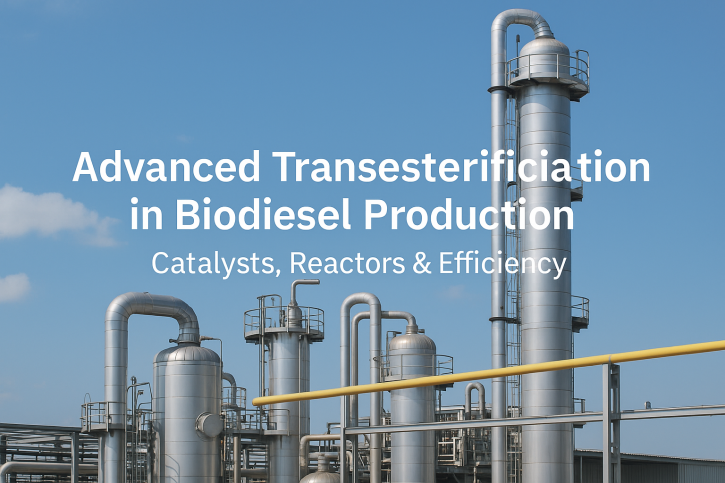
Advanced Transesterification Techniques in Biodiesel Production: Catalysts, Reactors & Efficiency Gains
Advanced transesterification is the foundation of modern biodiesel production—an engineered chemical transformation that converts renewable oils and fats into fatty acid methyl esters (FAME). With growing energy demand and tighter sustainability targets, the biodiesel sector is shifting from conventional batch chemistry toward continuous, high-efficiency systems. This article explores the evolution of transesterification technologies, advanced catalysts, and process optimizations that drive yield, purity, and scalability in 2025.
Understanding the Chemistry of Transesterification
Transesterification is a reversible chemical reaction between a triglyceride (the main component of vegetable oils or animal fats) and an alcohol—most commonly methanol—under the influence of a catalyst. The result is a mixture of FAME (biodiesel) and glycerol as a by-product:
Triglyceride + 3 Methanol ⇌ 3 Methyl Ester (Biodiesel) + Glycerol
The process is governed by equilibrium dynamics, meaning that reaction efficiency depends on several factors:
- Methanol-to-oil molar ratio – Typically 6:1 for optimal conversion; higher ratios shift equilibrium but require downstream methanol recovery.
- Catalyst type and concentration – Determines reaction kinetics and selectivity.
- Reaction temperature and mixing – Affects rate and phase contact between oil and methanol.
- Feedstock quality – Presence of free fatty acids (FFA) and water can deactivate catalysts and form soaps.
In industrial biodiesel production, reaction times are minimized (20–90 minutes) by optimizing these parameters and using intensified reactors that improve mass transfer between the immiscible phases.
Homogeneous Catalysis: The Traditional Backbone
For decades, homogeneous base catalysts—such as sodium hydroxide (NaOH) and potassium hydroxide (KOH)—have dominated the biodiesel industry due to their low cost and fast kinetics. They dissolve readily in methanol, forming an active methoxide ion (CH₃O⁻) that attacks the carbonyl group of triglycerides, yielding methyl esters.
Process Overview
The homogeneous alkaline process is typically conducted at 55–65°C, near the boiling point of methanol, and at atmospheric pressure. The reaction sequence involves:
- Mixing refined oil or fat with methanol and dissolved catalyst.
- Maintaining constant agitation to maximize phase contact.
- Allowing the reaction to reach 95–98% conversion within 1 hour.
- Settling or centrifuging to separate biodiesel (upper phase) and glycerol (lower phase).
Advantages
- Simple setup and well-established process design.
- Fast reaction rate and high conversion for low-FFA feedstocks.
- Suitable for continuous and batch operation modes.
Limitations
- Sensitive to free fatty acids (FFA) and water, which react with the catalyst to form soaps.
- Soap formation leads to emulsions, reducing phase separation and yield.
- Requires extensive washing and purification to remove catalyst residues and soaps.
- Limited reusability of catalyst and higher environmental impact from wastewater.
Despite these drawbacks, homogeneous catalysis remains economically viable for clean feedstocks like refined soybean or canola oil. However, as the industry embraces waste oils and animal fats with higher FFA content, alternative catalyst systems have become essential.
Acid-Catalyzed Transesterification
Acid catalysts—typically sulfuric acid (H₂SO₄) or hydrochloric acid (HCl)—are slower but more tolerant to impurities. They can simultaneously catalyze esterification of FFAs and transesterification of triglycerides, making them suitable for low-cost feedstocks.
Typical conditions include 1–2% acid catalyst, temperatures of 55–70°C, and longer reaction times (2–6 hours). The trade-off lies between flexibility and kinetics: while acids handle impurities better, they are slower and more corrosive, requiring stainless steel or lined reactors.
Applications
- Pre-esterification step for high-FFA feedstocks prior to base-catalyzed transesterification.
- Direct acid transesterification in integrated systems where water and FFA content are controlled.
Challenges
- High methanol-to-oil ratios (up to 20:1) required to shift equilibrium.
- Formation of emulsions and need for neutralization post-reaction.
- Corrosion and safety concerns due to acidic environment.
Recent process intensification methods—such as ultrasound-assisted acid catalysis and microwave heating—are overcoming these limitations, enabling faster kinetics even at moderate temperatures.
Transition to Advanced Catalysis
To improve sustainability, modern biodiesel plants are moving toward heterogeneous and enzymatic catalysts that allow continuous operation, catalyst reusability, and lower purification requirements. The shift also supports the use of non-edible and waste feedstocks, aligning with circular economy principles.
These advanced transesterification systems minimize chemical waste, simplify downstream purification, and achieve higher overall lifecycle efficiency. They represent the next generation of biodiesel process engineering—bridging economic and environmental performance.
Heterogeneous Catalysts: Toward Cleaner and Reusable Systems
Heterogeneous catalysis employs solid catalysts that remain in a separate phase from reactants, allowing easy recovery and reuse. Common materials include metal oxides (CaO, MgO, ZnO), zeolites, and supported catalysts on silica or alumina.
Unlike homogeneous systems, these catalysts eliminate the need for neutralization and water washing, producing cleaner biodiesel with lower waste generation. Reaction design focuses on surface area, porosity, and active site accessibility to ensure high conversion rates even for viscous feedstocks.
We’ll explore their mechanisms, reactor design, and industrial implementation in the next section.
Heterogeneous Catalysis: From Concept to Industrial Scale
In modern biodiesel plants, heterogeneous catalysts have become the preferred route for advanced transesterification. These catalysts offer simple separation, high recyclability, and lower wastewater generation, aligning with green chemistry principles. Unlike liquid bases or acids, heterogeneous catalysts remain solid throughout the process, simplifying downstream purification.
Common Catalyst Families
- Alkaline earth metal oxides – Calcium oxide (CaO) and magnesium oxide (MgO) are among the most widely studied. They are inexpensive, non-toxic, and easily recoverable, but require feedstocks with low moisture and FFA content to prevent deactivation.
- Transition metal oxides – Zinc oxide (ZnO), titanium dioxide (TiO₂), and zirconia (ZrO₂) provide better stability under humid conditions and can be functionalized for higher activity.
- Supported catalysts – Active components (K₂O, Na₂O, CaO) dispersed on porous supports such as alumina, silica, or zeolites to increase surface area and mechanical strength.
- Hydrotalcite and mixed oxides – Double-layered hydroxides offering tunable basicity and enhanced thermal stability, useful for continuous fixed-bed reactors.
Advantages of Heterogeneous Catalysis
- Easy catalyst recovery and reuse (up to 10 cycles in optimized systems).
- Reduced environmental impact due to absence of neutralization and washing steps.
- Higher product purity and simplified biodiesel purification.
- Potential for continuous operation with fixed-bed reactors.
Challenges and Solutions
Despite their advantages, heterogeneous catalysts face deactivation through leaching, poisoning, and sintering. Engineers address these issues by:
- Employing pre-treated feedstocks with low FFA and water content.
- Developing nanostructured catalysts with larger surface area and stable active sites.
- Using bifunctional catalysts that combine acid and base properties for mixed-feed applications.
These developments allow heterogeneous catalysts to compete with traditional alkali systems even for lower-grade feedstocks like waste cooking oil (WCO) and tallow.
Enzymatic Transesterification: The Biocatalytic Future
In pursuit of ultimate sustainability, enzymatic transesterification has emerged as a promising alternative. It utilizes lipases—enzymes that catalyze ester bond exchange—under mild conditions without forming soaps or requiring neutralization. The method produces both biodiesel and high-purity glycerol in a single step.
Reaction Mechanism
Lipases act at the oil–alcohol interface, breaking down triglycerides into diglycerides, monoglycerides, and methyl esters. Their high selectivity reduces by-products and minimizes downstream purification costs. Reactions typically occur at 35–50°C and atmospheric pressure.
Immobilized Enzymes
Modern systems use immobilized lipases (e.g., Novozyme 435) fixed on resin or silica carriers, allowing easy separation and reuse for up to 100 cycles. This approach increases enzyme stability and lowers operational costs.
Advantages
- No soap formation, even with high-FFA feedstocks.
- Mild conditions reduce energy consumption and thermal degradation.
- High-quality biodiesel and glycerol with minimal purification.
Limitations
- High enzyme cost and sensitivity to methanol inhibition.
- Slower reaction kinetics compared to alkaline catalysis.
- Need for precise control of methanol addition (stepwise or continuous feeding).
Recent research focuses on developing methanol-tolerant lipases and hybrid enzymatic–heterogeneous systems that combine biological selectivity with mechanical robustness.
Reactor Design and Engineering Advances
The success of advanced transesterification relies not only on chemistry but also on reactor design. Efficient mass transfer between immiscible oil and methanol phases is the key to achieving high yields in shorter times. Engineers have developed several reactor types to intensify the process.
1. Continuous Stirred-Tank Reactors (CSTRs)
These are widely used in medium-scale biodiesel plants for homogeneous and heterogeneous catalysis. Proper impeller design and optimized mixing speeds prevent phase separation and ensure uniform temperature distribution.
2. Fixed-Bed Reactors
Ideal for heterogeneous or enzymatic systems. Oil and methanol flow through a packed bed of catalyst particles under mild pressure. Continuous operation minimizes downtime, and catalyst replacement is straightforward.
3. Membrane Reactors
Integrate reaction and separation in a single unit. As biodiesel forms, membranes selectively remove it from the reaction mixture, driving equilibrium forward and improving conversion efficiency.
4. Microreactors and Tubular Reactors
These high-intensity systems offer excellent heat and mass transfer rates. Microreactors can achieve nearly complete conversion in minutes, making them suitable for decentralized or modular biodiesel production.
5. Reactive Distillation Systems
A cutting-edge approach combining reaction and distillation. Methanol is continuously evaporated and condensed, maintaining equilibrium conditions and facilitating separation of glycerol and FAME within the same column. This hybrid design reduces reactor volume and improves yield.
Process Intensification Techniques
Process intensification focuses on enhancing transesterification efficiency without increasing reactor size or energy demand. Techniques include:
- Ultrasound-assisted transesterification: Cavitation bubbles collapse, improving dispersion and contact between phases. Reaction time can be reduced by up to 70%.
- Microwave heating: Provides rapid volumetric heating and uniform temperature, avoiding hotspots and improving catalyst performance.
- Supercritical methanol process: Operates above 240°C and 8 MPa, where methanol acts as both solvent and reactant. No catalyst is needed, and reaction time drops to seconds, though energy costs are higher.
Hybrid Process Concepts
The integration of multiple enhancement methods—such as ultrasound-assisted heterogeneous catalysis or microwave-assisted enzymatic transesterification—has demonstrated the potential to deliver higher yields with reduced energy input. These approaches embody the spirit of advanced transesterification: combining chemistry, process design, and sustainability.
Feedstock Adaptation Strategies for Advanced Transesterification
Modern biodiesel production increasingly depends on low-cost, high-FFA feedstocks such as waste cooking oils (WCO), animal fats, and acid oils. These feedstocks reduce raw material costs but require robust pretreatment and transesterification strategies to maintain process efficiency.
Feedstock Pretreatment
- Filtration and degumming – Removes solid particles, phospholipids, and gums that could deactivate catalysts.
- Dehydration – Heating under vacuum or nitrogen purging to eliminate moisture (<0.05%) that causes soap formation.
- Acid esterification – Converts free fatty acids into esters before the main transesterification stage, reducing FFA content below 1%.
- Neutralization and bleaching – Removes color bodies and trace metals, improving downstream catalyst stability.
In advanced transesterification plants, pretreatment is often integrated with online sensors that monitor FFA, moisture, and phosphorus levels, automatically adjusting reagent dosages for consistent product quality.
Feedstock Flexibility and Catalyst Compatibility
Heterogeneous and enzymatic catalysts have improved tolerance toward variable feedstocks. Bifunctional catalysts combining acid and base sites allow simultaneous esterification and transesterification, enabling single-step conversion of complex oils.
This flexibility is key to the circular bioeconomy: enabling the valorization of waste fats, used frying oils, and even algal lipids into high-grade biodiesel while reducing dependence on edible feedstocks.
Process Control, Automation & Digitalization
The evolution of advanced transesterification goes hand in hand with automation and smart process control. Modern biodiesel facilities use real-time analytics and AI-based systems to maintain optimal reaction conditions and ensure consistent product quality.
Real-Time Monitoring Systems
- Online NIR and FTIR spectroscopy – Monitors methyl ester conversion and residual glycerides in real time.
- Digital temperature and pressure control – Maintains stable reactor conditions for better reproducibility.
- PLC and SCADA integration – Automates feed rates, mixing speeds, and methanol recovery to minimize operator intervention.
Data from these systems feed predictive algorithms that anticipate catalyst deactivation or phase separation issues, reducing downtime and waste. This is part of the Industry 4.0 transformation reshaping the renewable fuels sector.
Economic Perspective: CAPEX, OPEX & Efficiency
The economics of biodiesel production depend heavily on catalyst performance, feedstock cost, and process efficiency. The table below summarizes the comparative economic profiles of various transesterification technologies:
| Technology | CAPEX | OPEX | Main Advantages | Key Limitations |
|---|---|---|---|---|
| Homogeneous base catalysis | Low | Moderate | Simple and fast reaction, low equipment cost | Wastewater generation, limited to low-FFA oils |
| Heterogeneous catalysis | Moderate | Low | Reusable catalyst, cleaner product, continuous operation | Possible deactivation, requires pretreatment |
| Enzymatic catalysis | High | Low | No soap formation, mild conditions, reusable enzyme | High enzyme cost, methanol sensitivity |
| Supercritical methanol | High | Moderate | No catalyst, ultra-fast reaction, tolerant to impurities | High energy consumption, complex equipment |
Although initial investments for advanced systems are higher, the long-term savings in OPEX, purification costs, and catalyst recovery typically result in shorter payback periods (3–5 years for medium-scale facilities).
Sustainability & Lifecycle Impact
Environmental performance is a decisive factor in biodiesel competitiveness. Advanced transesterification supports sustainability through:
- Waste feedstock valorization – Turning used oils and animal fats into renewable fuel.
- Reduced chemical consumption – Thanks to solid and biocatalysts that eliminate neutralization steps.
- Lower energy demand – Via process integration and heat recovery.
- Improved carbon balance – Up to 85% reduction in lifecycle GHG emissions compared to fossil diesel.
Plants designed with energy integration and CO₂ recovery systems further enhance sustainability metrics and align with renewable fuel certification schemes such as ISCC, RSB, and RED II.
Future Outlook: Digital Biorefineries & Hybrid Systems
The future of biodiesel production lies in hybrid processes that combine catalytic, enzymatic, and physical separation technologies in digitally managed biorefineries. AI-driven optimization will enable continuous adaptation to feedstock variability and market fluctuations.
Research in nanostructured catalysts, methanol-tolerant enzymes, and modular reactor design points toward smaller, decentralized biodiesel units capable of local waste-to-fuel conversion—closing the loop in the renewable carbon cycle.
Conclusion
Advanced transesterification is redefining the biodiesel industry. From heterogeneous and enzymatic catalysis to membrane and reactive distillation reactors, innovations are improving both process efficiency and environmental performance. As automation and digital monitoring become standard, biodiesel plants are evolving into smart, adaptive biorefineries that convert diverse feedstocks into sustainable fuels with high purity and lower cost.
These advances not only enhance profitability but also reinforce the role of biodiesel as a key player in the global energy transition.
Want to explore the entire biodiesel production chain — from feedstocks to purification and market outlook?